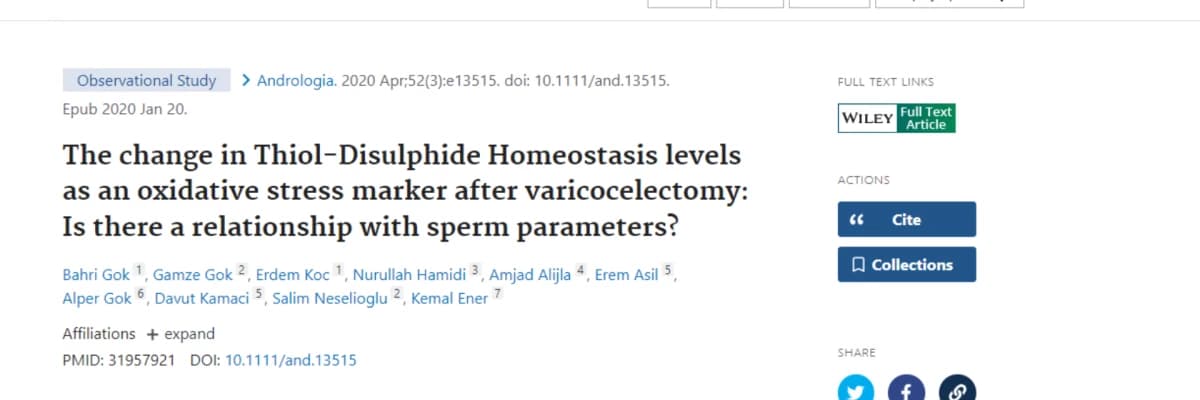
The change in Thiol-Disulphide Homeostasis levels as an oxidative stress marker after varicocelectomy: Is there a relationship with sperm parameters?

- Varikoselektomi ameliyatı, kısırlıkla ilişkili olan oksidatif stresi azaltarak toplam ve yerel tiyol seviyelerinde belirgin bir artış sağlar.
- Tiyol-disülfit dengesindeki iyileşme; sperm hacmi, morfolojisi ve hareketliliği gibi temel sperm parametreleriyle doğrudan ve pozitif bir ilişki içerisindedir.
- Tiyol-disülfit homeostazı, varikosel hastalarında cerrahi müdahale sonrası oksidatif stresi ve üreme sağlığındaki gelişimi takip etmek için güvenilir bir yöntemdir.
İçerik yapay zeka ile optimize edilmiştir
Varicocelectomy, Oxidative Stress, and Thiol-Disulphide Homeostasis
Oxidative stress (OS) is recognized as one of the most critical factors contributing to infertility in men with varicocele. To better understand this relationship, researchers have identified thiol-disulphide homeostasis (TDH) as a significant marker of oxidative stress levels. This study explores the hypothesis that surgical intervention, specifically varicocelectomy, effectively reduces oxidative stress and improves reproductive outcomes.
Study Methodology and Patient Data
In this prospective analysis, the data of 56 infertile men diagnosed with varicocele were examined. The primary objective was to investigate the direct relationship between TDH levels and sperm parameters following surgical treatment. By monitoring these specific biomarkers, the study aimed to validate the efficacy of varicocelectomy in restoring physiological balance.
Significant Changes in Thiol Levels Post-Surgery
The research findings demonstrated a substantial increase in both total and native thiol levels after the procedure. These results indicate a significant reduction in oxidative stress markers following a successful varicocelectomy. The comparative data is summarized below:
| Parameter | Pre-operative Level (nmol/L) | Post-operative Level (nmol/L) |
|---|---|---|
| Total Thiol | 436.7 | 477.7 |
| Native Thiol | 372.1 | 417.6 |
Correlation Between Thiol Homeostasis and Sperm Quality
A strong positive correlation was observed between the improvement in thiol-disulphide homeostasis and various sperm parameters. Specifically, the increase in total thiol levels was directly linked to enhancements in the following areas:
- Semen volume (ρ: .277, p: .039)
- Ratio of spermatozoa with normal morphology (ρ: .342, p: .01)
- Progressive motility (ρ: .334, p: .012)
- Nonprogressive motility (ρ: .385, p: .003)
Furthermore, native thiol changes also showed a positive correlation with semen volume, normal morphology, and both progressive and nonprogressive motility. These statistics reinforce the connection between reduced oxidative stress and improved sperm health.
Conclusion: TDH as a Diagnostic Tool
The study concludes that varicocelectomy effectively decreases oxidative stress in infertile patients. The positive correlation between TDH level changes and improvements in progressive and nonprogressive motility suggests that thiol-disulphide homeostasis is a highly useful and reliable method for measuring oxidative stress in clinical settings.